


The Ulbster 2 Pictish Stone


Removal of the Stone from the Burial Ground

Erecting the Stone within the NCVC Stone Room

The Ulbster 1 Stone, also in the NCVC
In autumn 2022 a new Pictish stone was discovered in a burial ground in Ulbster, Caithness, the same burial ground in which the magnificent "Ulbster Stone" was identified in 1770. The original Ulbster Stone is on display in the North Coast Visitor Centre (previously Caithness Horizons). This is the story of how the Ulbster 2 Stone was discovered, removed, conserved and finally erected for display in the same room as Ulbster 1.
The Finding of the Ulbster 2 Stone in the Ulbster Burial Ground
"New" Pictish stones keep being discovered. Important contributions to the corpus of Pictish Art in recent years have been the Conan Stone in 2020 and the new Aberlemno stone in March 2022. In Caithness, in autumn 2022, a new Pictish stone emerged from the same burial ground in which the Ulbster Stone was found in 1770. This second Ulbster stone was found by a local resident with an interest in Family History. Yarrows Heritage was asked to manage its removal from the burial ground, it’s conservation and then eventual presentation in a local museum. Fiona Begg Wade now lives in Thurso but was brought up in the village of Ulbster on the coast just south of Wick. With her background in Family History, and her love of the burial ground near where she used to play as a child, she started to record the memorial inscriptions of the burial markers in the old St Martin’s Burial Ground at Ulbster. Separated from the village by a low hill, the burial ground near Ulbster Mains farm used to surround an old chapel, of which no trace now exists. In the early 18th century, a mausoleum for the Sinclair family was built in the burial ground, perhaps on the site of the former old chapel. It bears the inscription 1700 on the weathervane. The burial ground bears the name of St Martin, probably the saint name of the chapel In early September 2022 Fiona was in the burial ground cleaning turf and soil off some of the burial markers, better to see the inscriptions. This is her description of the finding of the stone: “On one visit to Ulbster Burial Ground I felt something underfoot, and after removing a little of the soil I uncovered a flat gravestone. This gravestone had an inscription for someone who belonged to my family tree. I continued to remove more soil and uncovered more stones. Not all the flat stones had inscriptions, half of them were blank. There were two ladies who had recorded most of the cemeteries in Caithness over thirty years ago. I use their books all the time. These gravestones were not visible at that time, so they had not recorded them. I wanted to photograph and record them. I was working along the row of stones that I had uncovered when I came to a flat stone that was mostly under the soil. While brushing away the soil I noticed some wavy lines, my first thought was that this one had an inscription. Once it was fully uncovered the pattern stood out, it looked amazing. I knew that it was a Pictish stone.” Fiona involved her daughter’s partner, Hamish Lamley of Pictavia Leather in Perth, who has experience of Pictish markings, and he confirmed that the markings were Pictish. He knew Professor Gordon Noble of Aberdeen University, who then came up to have a look at the stone. Professor Noble confirmed that this was indeed a Pictish stone. So, a second Pictish stone has been discovered in St Martin’s Burial Ground at Ulbster, matching the one previously found there in 1770, which is now on display in the North Coast Visitor Centre (previously Caithness Horizons) in Thurso.
What was the stone doing in the Burial Ground?
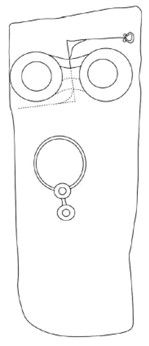
The early history of this newly discovered second stone from the Ulbster burial ground is unknown. The decoration is simpler than Ulbster 1 Stone, suggesting that it is earlier, between the 5th & 7th centuries. In the jargon of Pictish stones this would be a Class I stone, ie containing Pictish symbols but not a Christian cross or iconography. Presumably it stood erect somewhere, before it was laid alongside other re-arranged burial markers on the east side of the Ulbster Burial Ground. We don’t know whether the stone was originally erected as a Pictish stone at this site, whether it was one of several upright stones within the curtilage of the hallowed space, or whether it was brought from elsewhere to be stored or used in the burial ground. From its position, packed tightly in a row of other large stones, and its lack of inscription, it may be that it was never used as a burial marker. This contrasts with the Conan Stone which had been re-used as a grave marker and bears the names of two individuals who died in 1797. This is what John Borland, immediate past President of the Society says of the stone: “Caithness is home to significantly fewer Pictish symbol stones than neighbouring Sutherland. This may in part be due to the acquisitive habits of successive Dukes of Sutherland who actively sought and collected Pictish sculpture in Sutherland. Therefore, a new symbol stone from Caithness is a significant discovery and an important addition to that county's corpus. Its location, St Martin's Chapel, Ulbster is also notable. The Ulbster Stone, a Pictish cross slab was discovered there in 1770. The correlation of an incised symbol stone and a symbol-bearing cross slab from the same location arguably reinforces the theory that Pictish Christian chapels were often deliberately established on existing pre-Christian ritual sites. This discovery will keep archaeologists and art historians busy for some time to come.”
A description of the Stone
The symbols on the upper surface of the stone are an elaborate double disc and Z-rod at the top of the stone, and a mirror further down the face. The double¬ disc is damaged with the lower part of the Z-rod missing. The upper part of the Z-rod has a very well-formed termination, in the form of an elaborate 'U'. The handle of the mirror is deeply incised, but the round face of the mirror is only traceable in certain lights. Other symbols (and perhaps a comb) could have been present on parts of the stone now delaminated. The symbols have been much weathered and have now lost the crispness seen on the first Ulbster Stone. However, by using certain photographic techniques the symbols can be highlighted. The original underside of the stone, as it lay in the burial ground, is plain and unmarked. The five images below include three various photographic processes to enhance the inscriptions, courtesy of Professor Noble and Douglas Ledingham.




Details of the Conservation of the Stone
In Graciela Ainsworth’s Ratho workshop the stone was carefully lifted and placed onto a new pallet with Plastazote softening beneath it. The stone was then given a dry clean using soft bristle brushes and wooden spatulas to remove any mud and organic growth, such as mosses and lichens. Following this the stone was carefully wet cleaned with potable water and nylon brushes. It was then treated with D/2 biocide to lessen any remaining organic growth. The stone was left to fully dry before being photographed and surveyed to assess its condition. Some of the organic growth was well attached to the stone. Persistent lichens were removed using wooden spatulas and bamboo skewers before a second application of D/2 biocide solution was applied to the surface of the stone to prevent regrowth. Once dry, delaminations and fissures could be treated. Open fissures were consolidated using a solution of Paraloid B72 in acetone (12% w/v) mixed with fine silica sand, micro balloons and natural earth pigments to match the colour and texture of the surrounding stone. Hollow pockets beneath the stone surface were consolidated by injecting a solution of Paraloid B72 in acetone (12% w/v) using syringes and fine hypodermic needles. Injection holes were then capped with the Paraloid B72 in acetone (12% w/v) mixed with fine sand, micro balloons and natural earth pigments. Recent abrasions across the surface of the stone were toned out with fine artists acrylic paints to lessen their visual impact.
Erection of the Ulbster 2 Stone in the Stone Room of the North Coast Visitor Centre
After conservation the stone came back north to rest in the NCVC (North Coast Visitor Centre, Thurso) while arrangements were made for it to be erected within the magnificent Stone Room. This allows it to take its place alongside the other Pictish Stones in that room. The design of the supporting plinth for the stone was undertaken by Nigel Greenwood, Structural Engineer, formerly of Wallace Stone. The construction of the plinth and stand, and the actual erection into its place in the room, was in undertaken by Norbloc Construction of Thurso. The unveiling of the Stone on June 13th 2025 was undertaken by Lord Thurso, on whose land the stone was found.
We are grateful to our funders...
The management of the stone from burial ground to museum was achieved through the generous funding of many people and organisations: Local donations and crowdfunding via Paypal, the Pictish Arts Society, Lybster & Tannach Fund, Caithness & North Sutherland Fund, Historic Environment Scotland.
We are grateful to those who undertook the work on the Stone:
Graciela Ainsworth, Stone Conservator in Ratho, Edinburgh.
ERCO Lighting.
Nigel Geenwood, Structural Engineer of Wallace Stone Consulting Engineers.
Willie Campbell & colleagues of Norbloc Construction Ltd, Thurso.
Final thanks...
We acknowledge the inspiration Fiona Begg Wade had in clearing the burial ground, recognising the nature of the stone, and doing the right thing by it.
And we are grateful to Susan Taylor and her colleagues, employees of Highlife Highland, who manage and run the North Coast Visitor Centre.

The Ulbster 2 Stone (third from left) lying in situ in St Martin's Burial Ground in Ulbster, in front of the mausoleum

Fiona Begg Wade & her niece, Sarah, in the burial ground © David Scott

Conserving the Stone in Leith workshop
© Graciella Ainsworth

Lord Thurso immediately after his unveiling of the stone,
with Roland Spencer-Jones, Chair of Yarrows Heritage
© Angus Mackay Photography


